

Solo on the trail, no crew, no one to hold the camera. A practical guide to getting the shot anyway, with JOBY gear built for exactly that situation.

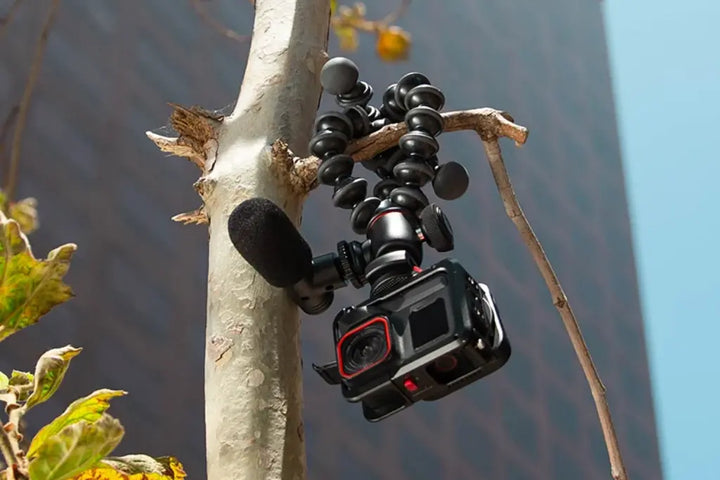
GorillaPod® 3K Tripod wrapped around a trail branch. Independently poseable legs conform to rocks, roots, and slopes where fixed-leg stands fall over.
Filming yourself while hiking alone is one of the more specific problems in solo content creation. A fixed-leg tripod falls over on uneven ground. A phone propped against a rock gives you one angle and no control over when you shoot. A ten-second self-timer means walking back to your phone before it fires, then walking away again, and hoping the framing is still right. This guide covers the gear that actually solves these problems, and how to use it on the trail.
Why Solo Hiking Footage Is Harder to Capture Than It Looks
On flat ground with a clear sightline, solo filming is a manageable challenge: you need something to hold the camera while you walk in front of it. Hiking adds complications. The ground is rarely flat. Available surfaces include rocks, roots, branches, fence posts, and trail markers rather than tabletops. And because you're moving between locations continuously, whatever you carry needs to set up in seconds.
The other problem is triggering. Once your camera is positioned and you've walked 20 feet down the trail, you need a way to start recording. Self-timer works once, but for multi-take setups you're walking back to the camera every single time. That's what eats your time on the trail, and it's the part that good gear eliminates entirely.
The Three Things You Actually Need
A stable mount that works on uneven surfaces. Standard tripods need level ground, and hiking trails rarely offer that. A flexible leg system that conforms to rocks, roots, and slope is the difference between a shot you actually get and one you walk past.
Hands-free triggering. A self-timer is a workaround. A wireless remote is a solution. Being able to step into frame and start recording from wherever you're standing removes the back-and-forth entirely.
Fast setup. A rig that takes five minutes to configure will get used twice per hike. The gear you reach for is the gear you can set up in 30 seconds and break down just as fast. Everything below clears that bar.
Choosing Your Support
Three options cover the range of solo hiking needs. GorillaPod leads this list because on a trail, the terrain is the main variable, and flexible legs that conform independently to rocks, roots, and inclines solve the problem that every fixed-leg stand cannot. The right choice from there depends on your camera setup, your carry preference, and whether hands-free triggering is a priority.
1. The Best Tripod for Hiking Terrain
Recommended: GorillaPod® 1K Tripod or GorillaPod® 3K Tripod
Compatible Devices: Compact cameras and mirrorless cameras (1/4" thread, no adapter needed); action cameras and smartphones via optional 1/4" adapter
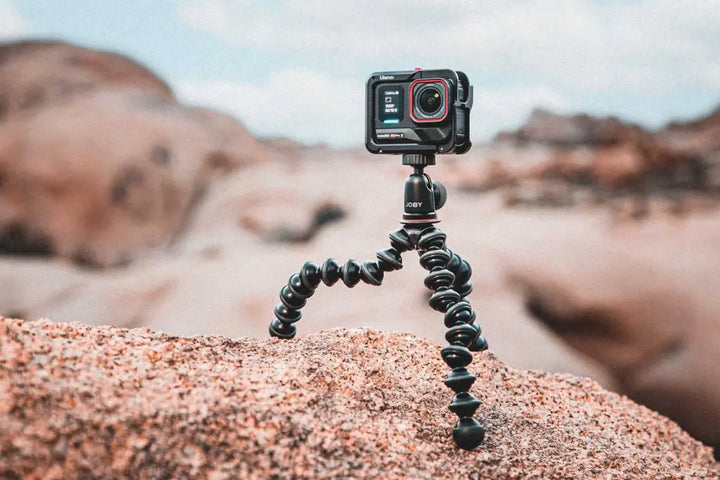
GorillaPod is the flagship JOBY product for a reason, and that reason is particularly clear on hiking trails. Each leg is independently poseable and stays locked in whatever position you set it to, so the tripod conforms to rocks, roots, soil, and inclines where every fixed-leg stand would simply tip over. You're not looking for flat ground. You're placing each leg wherever it finds grip and building a stable base out of whatever the trail offers. Rubberized feet grip tree bark, stone, and anything else you can imagine.
GorillaPod® 1K supports up to 1kg (2.2lbs), covering compact cameras, action cameras, and most smartphone setups with the right adapter. GorillaPod® 3K handles up to 3kg (6.6lbs) with larger ball joints and a quick-release plate system, making it the call for mirrorless cameras and heavier rigs. Both wrap around branches, grip fence posts, stand on boulders, and hold position on slopes that nothing else in this lineup can match.
Best for: any terrain, camera users, hikers who need a stable base on slopes and rocky ground, the most versatile placement options on trail

GorillaPod® 3K Tripod

GorillaPod® 1K Tripod
2. For Hands-Free Triggering and Selfie Stick Mode
Recommended: TelePod® Mini Tripod
Compatible Devices: Smartphones only (physical clamp)
TelePod® Mini is the only phone stand in this lineup that includes a wireless remote out of the box. The detachable remote works from 33 feet away, covers all the distance you need for a walking shot on a trail, and charges via USB-C so it's always ready. Position your phone, step into frame, and start recording without going back to the camera. For repeated takes at multiple locations, this is the most practical triggering setup available.
One thing worth knowing: TelePod® Mini has fixed tripod legs, not flexible ones. On flat or near-flat surfaces, a rock ledge, a trailhead bench, or a log, it's a stable and capable stand. On inclines and loose terrain it needs a reliable resting surface to work from, which GorillaPod does not. Where TelePod® Mini consistently earns its place is in selfie stick mode and remote-triggered tripod setups on usable surfaces. The 14.8-inch extension, 360° rotation, 225° tilt, and included 5600K fill light make it the most complete phone-shooting kit in this guide. A carabiner lanyard clips the whole unit to a pack strap between setups.
Best for: phone shooters who film multiple takes at different locations, selfie stick and handheld modes on the trail, setups where a flat resting surface is available


3. For Wrapping, Sticking, and Phone-Only Setups
Recommended: PodZilla® Octo Suction Tripod
Compatible Devices: Smartphones only (magnetic mount)
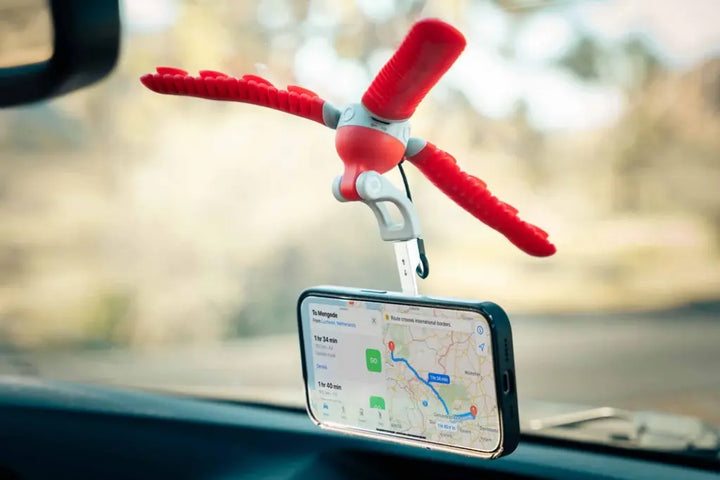
PodZilla® Octo and GorillaPod both have flexible legs that wrap around branches and grip uneven surfaces, so the meaningful difference between them comes down to your camera setup and what surfaces you're shooting near. If you're hiking with a smartphone, PodZilla® Octo is a strong option at 146g. If you're carrying a compact camera or mirrorless, GorillaPod is the one with a 1/4" thread to connect it.
But PodZilla® Octo adds something GorillaPod does not: suction cup tips on each leg. The legs wrap around branches or rocks, and the suction cups lock onto smooth surfaces like car windows, railings, and glass where wrapping is not an option. A magnetic phone mount snaps your phone on in seconds and supports 360° pan with 200° tilt. Splash-resistant and 146g, it travels easily and a carabiner lanyard clips it to your bag for trail carry.
Best for: phone shooters on varied terrain, trails that pass near structures and smooth surfaces, anyone who wants flexible legs and suction cup mounting in one tool


What's In Your Kit: A Quick Reference
The three options compared across the specs that matter most on a hiking trail.
| GorillaPod® 1K / 3K | TelePod® Mini | PodZilla® Octo | |
|---|---|---|---|
| Weight | 1K: 196g / 3K: 393g | 135g | 146g |
| Compatible devices | Cameras native (1/4" thread); phones and action cameras via optional adapter | Smartphones only | Smartphones only |
| Works on uneven ground | Yes (each leg poses independently to terrain) | Needs a flat or stable resting surface | Yes (flexible legs wrap; suction cups grip smooth surfaces) |
| Wireless remote | No | Yes (33ft / 10m) | No |
| Trail carry | Side pocket or pack | Carabiner lanyard (clips to pack) | Carabiner lanyard (clips to pack) |
| Load capacity | 1K: 1kg / 2.2lb; 3K: 3kg / 6.6lb | 500g / 1.1lb | 500g / 1.1lb |
Frequently Asked Questions
What tripod is best for solo hiking content?
GorillaPod is the strongest all-around pick for hiking specifically because the flexible legs conform to the terrain rather than requiring the terrain to be flat. On inclines, rocks, and roots, each leg poses independently to find a stable base that fixed-leg tripods cannot build. GorillaPod® 1K covers phone and action camera setups with the right adapter, while GorillaPod® 3K handles compact and mirrorless cameras natively. For phone shooters who want hands-free triggering on top of that, TelePod® Mini's 33-foot wireless remote is the most practical add.
How do I film myself hiking without someone holding the camera?
Two things are required: a mount that stays stable at the location you've chosen, and a way to trigger the shutter after you've walked into frame. For the mount, GorillaPod gives you the most placement options on trail terrain because the legs work on uneven ground without needing a flat surface. For the trigger, TelePod® Mini's wireless remote lets you start recording from up to 33 feet away, removing the need to walk back to the camera between takes.
Can I use a phone tripod on uneven ground while hiking?
A standard fixed-leg tripod needs level ground to stay upright, which rules out most trail surfaces. Flexible tripods like GorillaPod® 1K and GorillaPod® 3K solve this by letting each leg pose independently to whatever surface is available, including rocks, roots, and slopes. PodZilla® Octo works the same way for phone setups, with suction cup tips that add attachment options on smooth surfaces. For a flat-leg stand like TelePod® Mini, you'll want to find a rock, log, or ledge that provides a stable platform.
What is the difference between GorillaPod and PodZilla Octo for hiking?
Both have flexible legs that wrap around branches and grip uneven surfaces, but they differ on two points. First, camera support: GorillaPod connects directly to any camera with a standard 1/4" thread, covering compact cameras, mirrorless cameras, and action cameras with an adapter. PodZilla® Octo uses a magnetic mount designed for smartphones only. Second, surface attachment: PodZilla® Octo has suction cup tips on the legs that grip smooth surfaces like glass, which GorillaPod's rubberized feet do not. If you're hiking with a camera, GorillaPod is the pick. If you're hiking with a phone and want suction cup mounting as an option, PodZilla® Octo adds that capability.
Do I need a wireless remote to film myself hiking?
A wireless remote isn't strictly required, but it removes the most consistent friction point in solo trail setups. Without one, every take requires walking back to the camera to reset the self-timer. On a long hike with multiple setups, that adds up fast. TelePod® Mini is the only product in this lineup that includes a wireless remote in the box. If you're running a single fixed camera position and don't mind using the timer, GorillaPod or PodZilla® Octo will both work without one.
What tripod wraps around tree branches for hiking shots?
GorillaPod was built for this use case. Each leg bends and holds position independently, letting you coil the tripod around a branch, grip it onto a fence post, or conform it to a root structure that no fixed stand could touch. GorillaPod® 1K handles up to 1kg (2.2lbs) for compact camera setups, and GorillaPod® 3K handles up to 3kg (6.6lbs) for heavier mirrorless rigs. PodZilla® Octo also wraps around branches for phone-only setups, with suction cup tips as an additional attachment option.
How should I carry a tripod while hiking?
TelePod® Mini and PodZilla® Octo both include a carabiner lanyard that clips to a pack strap or belt loop, keeping them accessible without opening your bag. GorillaPod folds compactly enough to slide into a side pocket or pack without taking up meaningful space.
Shop JOBY Hiking Tripods
All products are available at joby.com.
About JOBY
Born in California in 2005, JOBY builds creative tools for explorers and creators who refuse to let their environment dictate what they can capture. From GorillaPod® to NanoPod, every JOBY product is designed to adapt to you, not the other way around. JOBY is part of the VIJIM Group.
###